 Cheng Wan
d13d5c03ab
Cheng Wan
d13d5c03ab
`--attention-backend` is one field of three: a launch that sets only
`--prefill-attention-backend` or `--decode-attention-backend` leaves the base
field at `None`. Seven decisions read that base field alone and therefore
answered from a field the operator never set. `attention_backends()` is the
pair with the base-field fallback already applied, so each site now asks it for
the half it actually needs:

- `inkling_common/attn` assembles backend-specific kwargs (rel_bias / score
  mods) and gates its fused prologue; the backend those describe is the one
  `self.attn` dispatches to, so `serving_attention_backend()` selects the pair
  member by `forward_batch.forward_mode`, mirroring
  `HybridAttnBackend._select_backend` exactly -- draft-extend routes through
  the prefill branch like the dispatcher does -- and preferring the
  runner-stamped pair, so a draft runner answers with its own backend. That
  preference only works if every backend that can enter a ForwardContext
  carries the stamp, so `DraftBackendFactory._create_backend` now stamps its
  products with the backend it resolved (draft override first), and the
  draft-extend conv-sidecar wrapper copies the wrapped backend's stamp -- the
  replacement backends the spec workers install had no stamp at all and fell
  back to the target's configured pair.
- The chunked-prefix-cache gate is a *prefill* feature -> prefill half. Reading
  the base field switched the feature off for every prefill-only configuration.
- `init_deterministic_inference_config` maps *prefill* knobs
  (SPLIT_TILE / PREFILL_TRUNCATION_ALIGN) -> prefill half; the map missed and
  left truncation unset.
- `two_batch_overlap` computes extend positions -> prefill half.
- mrope's interleaved-rope kernel runs in both phases -> both halves must
  support triton. This one is not conservative when it misreads:
  `support_triton(None)` answers **True**, so a `--prefill-attention-backend
  torch_native` launch took the triton path.
- The req-to-token writer has one caller, `alloc_for_extend` -> prefill half;
  its fallback pays several `.item()` syncs per request, so gating it on the
  decode half too would send every extend of a mixed launch through the slow
  path. `get_last_loc` (the spec-decode allocator's helper) keeps the
  both-halves reading: verify tokens are served by either half depending on
  `speculative_attention_mode`.
- The flashinfer version floor is a guard; it never fired for a launch that
  pinned flashinfer through a split field.

One more site the census found is not converted here: `gpt_oss` derives its
`sinks` parameter dtype from the backend, and a single parameter dtype cannot
serve a split pair (FA4 asserts bfloat16, trtllm_mha consumes float32), so
that one is a behaviour question rather than a config-source one and is fixed
in its own PR.

`test_split_attention_backend_decisions.py` pins the callable decisions by
calling them under a split-only publish, and pins the remaining ones
statically -- the file/why map fails if any of them goes back to the base field
(reverse-verified). It also asserts the `support_triton(None) is True` trap the
sweep exists for.

The stamp comes from the constructor, not the request: every factory leaf
answers ("effective_name", backend), because several map entries do not build
what their key says -- cutedsl_mla draft-extend builds the trtllm-mla backend,
"nsa" is a deprecated alias building dsa, and the hybrid-linear entries pick
fa3/intel_amx/triton by host, which no static rename table can express (a
review catch: on Blackwell the alias stamp reached Inkling's per-forward
kwargs assembly, which asserts a concrete kernel name, and crashed the first
draft-extend forward). The stamping is pinned by unit tests, not only by a
spec e2e: removing the child-stamping loop, stamping an alias from a leaf, or
dropping the wrapper copy goes red (reverse-verified), and a static guard
walks the factory source asserting no leaf answers an alias name. The child loop states its contract explicitly --
`create_decode_backend` passes `stamps_children=True` because its products
are per-step containers by construction, so a container without
`attn_backends` raises instead of being silently skipped by a defensive
probe. The `_version` invalidation names its contract (autograd's in-place
counter: private, chosen because it is the only per-tensor signal that ticks
on copy_-style updates; removal fails loudly). The version-floor guard's file
joins the pair-reader ratchet, and the one runner-seed chain read sharing the
backend's __init__ (`speculative_eagle_topk`) reads the spec bag.







Blog | Documentation | Roadmap | Join Slack | Weekly Dev Meeting | Slides
News
- [2026/07] 🔥 SGLang and Miles add day-0 support for Kimi K3 (blog).
- [2026/07] RadixArk and Google bring full SGLang features to TPUs (blog).
- [2026/07] Serving GLM5.2 NVFP4 agentic workloads with SGLang: Reaching 500 TPS in two weeks (blog).
- [2026/06] 🔥 The next generation of speculative decoding: DFlash and Spec V2 (blog).
- [2026/06] SGLang provides day-0 support for latest open models (Nemotron 3 Ultra, Nemotron 3 Super, Higgs Audio v3 TTS).
- [2026/04] 🔥 DeepSeek-V4 on Day 0: From Fast Inference to Verified RL with SGLang and Miles (blog).
- [2026/02] 🔥 Unlocking 25x Inference Performance with SGLang on NVIDIA GB300 NVL72 (blog).
- [2026/01] SGLang Diffusion accelerates video and image generation (blog).
More
- [2025/12] SGLang provides day-0 support for latest open models (MiMo-V2-Flash, Nemotron 3 Nano, Mistral Large 3, LLaDA 2.0 Diffusion LLM, MiniMax M2).
- [2025/11] SGLang Diffusion accelerates video and image generation (blog).
- [2025/10] SGLang now runs natively on TPU with the SGLang-Jax backend (blog).
- [2025/10] PyTorch Conference 2025 SGLang Talk (slide).
- [2025/10] SGLang x Nvidia SF Meetup on 10/2 (recap).
- [2025/09] Deploying DeepSeek on GB200 NVL72 with PD and Large Scale EP (Part II): 3.8x Prefill, 4.8x Decode Throughput (blog).
- [2025/09] SGLang Day 0 Support for DeepSeek-V3.2 with Sparse Attention (blog).
- [2025/08] SGLang x AMD SF Meetup on 8/22: Hands-on GPU workshop, tech talks by AMD/xAI/SGLang, and networking (Roadmap, Large-scale EP, Highlights, AITER/MoRI, Wave).
- [2025/08] SGLang provides day-0 support for OpenAI gpt-oss model (instructions)
- [2025/06] SGLang, the high-performance serving infrastructure powering trillions of tokens daily, has been awarded the third batch of the Open Source AI Grant by a16z (a16z blog).
- [2025/06] Deploying DeepSeek on GB200 NVL72 with PD and Large Scale EP (Part I): 2.7x Higher Decoding Throughput (blog).
- [2025/05] Deploying DeepSeek with PD Disaggregation and Large-scale Expert Parallelism on 96 H100 GPUs (blog).
- [2025/03] Supercharge DeepSeek-R1 Inference on AMD Instinct MI300X (AMD blog)
- [2025/03] SGLang Joins PyTorch Ecosystem: Efficient LLM Serving Engine (PyTorch blog)
- [2025/02] Unlock DeepSeek-R1 Inference Performance on AMD Instinct™ MI300X GPU (AMD blog)
- [2025/01] SGLang provides day one support for DeepSeek V3/R1 models on NVIDIA and AMD GPUs with DeepSeek-specific optimizations. (instructions, AMD blog, 10+ other companies)
- [2024/12] v0.4 Release: Zero-Overhead Batch Scheduler, Cache-Aware Load Balancer, Faster Structured Outputs (blog).
- [2024/10] The First SGLang Online Meetup (slides).
- [2024/09] v0.3 Release: 7x Faster DeepSeek MLA, 1.5x Faster torch.compile, Multi-Image/Video LLaVA-OneVision (blog).
- [2024/07] v0.2 Release: Faster Llama3 Serving with SGLang Runtime (vs. TensorRT-LLM, vLLM) (blog).
- [2024/02] SGLang enables 3x faster JSON decoding with compressed finite state machine (blog).
- [2024/01] SGLang provides up to 5x faster inference with RadixAttention (blog).
- [2024/01] SGLang powers the serving of the official LLaVA v1.6 release demo (usage).
About
SGLang is a high-performance serving framework for large language models and multimodal models. It is designed to deliver low-latency and high-throughput inference across a wide range of setups, from a single GPU to large distributed clusters. Its core features include:
- Fast Runtime: Provides efficient serving with RadixAttention for prefix caching, a zero-overhead CPU scheduler, prefill-decode disaggregation, speculative decoding, continuous batching, paged attention, tensor/pipeline/expert/data parallelism, structured outputs, chunked prefill, quantization (FP4/FP8/INT4/AWQ/GPTQ), and multi-LoRA batching.
- Broad Model Support: Supports a wide range of language models (Llama, Qwen, DeepSeek, Kimi, GLM, GPT, Gemma, Mistral, etc.), embedding models (e5-mistral, gte, mcdse), reward models (Skywork), and diffusion models (WAN, Qwen-Image), with easy extensibility for adding new models. Compatible with most Hugging Face models and OpenAI APIs.
- Extensive Hardware Support: Runs on NVIDIA GPUs (GB200/B300/H100/A100/Spark/5090), AMD GPUs (MI355/MI300), Intel Xeon CPUs, Google TPUs, Ascend NPUs, and more.
- Active Community: SGLang is open-source and supported by a vibrant community with widespread industry adoption, powering over 400,000 GPUs worldwide.
- RL & Post-Training Backbone: SGLang is a proven rollout backend used for training many frontier models, with native RL integrations and adoption by well-known post-training frameworks such as AReaL, Miles, slime, Tunix, verl and more.
Getting Started
Benchmark and Performance
Learn more in the release blogs: v0.2 blog, v0.3 blog, v0.4 blog, Large-scale expert parallelism, GB200 rack-scale parallelism, GB300 long context.
Adoption and Sponsorship
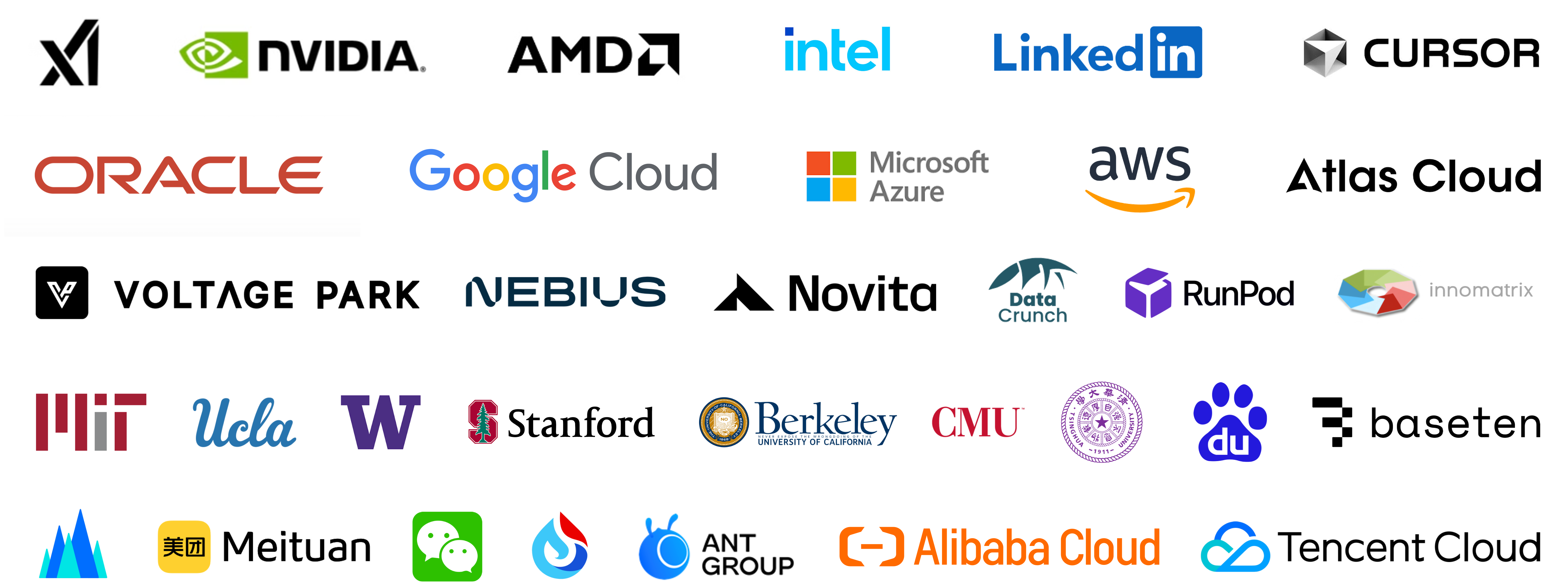
SGLang has been deployed at large scale, generating trillions of tokens in production each day. It is trusted and adopted by a wide range of leading enterprises and institutions, including xAI, NVIDIA, AMD, Intel, LinkedIn, Cursor, Oracle Cloud, Google Cloud, Microsoft Azure, AWS, Atlas Cloud, Voltage Park, Nebius, DataCrunch, Novita, RunPod, InnoMatrix, Modal, MIT, UCLA, the University of Washington, Stanford, UC Berkeley, Tsinghua University, Baseten, Baidu, AntGroup, Alibaba, Tencent, and other major technology organizations. As an open-source LLM inference engine, SGLang has become the de facto industry standard, with deployments running on over 400,000 GPUs worldwide. SGLang is currently hosted under the non-profit open-source organization LMSYS.
Contact Us
For enterprises interested in adopting or deploying SGLang at scale, including technical consulting, sponsorship opportunities, or partnership inquiries, please contact us at sglang@lmsys.org.
Long-term active SGLang contributors are eligible for coding agent sponsorship, such as Cursor, Claude Code, or OpenAI Codex. Email sglang@lmsys.org with your most important commits or pull requests.
Acknowledgment
We learned the design and reused code from the following projects: Guidance, vLLM, LightLLM, FlashInfer, Outlines, and LMQL.