 Cheng Wan
45c24444b1
Cheng Wan
45c24444b1
First of five. The stack continues a series that moved configuration out of
`ServerArgs` and into the runtime context's namespace bags. This one fixes
something that was actually broken, and gives the fix its other half.

## "Unset" gets its own spelling on two ratio fields

`swa_full_tokens_ratio` and `mamba_full_memory_ratio` carried real values as
their class defaults (0.8, 0.9), so a model family with an opinion had to ask
"is this field still equal to the class default?" to find out whether the
operator had set it. That question has two wrong answers: it says "the operator
set it" as soon as any earlier pass declares the field, and it says "the
operator did not set it" when the operator types the default value.

Both become `Optional[float] = None`. The record carries what the operator typed
and nothing else, and the family test becomes `is None`.

`mamba_radix_cache_strategy` keeps `"auto"`: unlike the ratios it already has a
spelling for "unset" that an operator can type and that means exactly that --
only its comparison changes, from the class default to the token itself, which
is the fix the comment at that site already prescribed. With that, neither
family module imports `ServerArgs` any more.

## And the declaration says what the field means when nobody answers

Making the default `None` leaves a hole: something has to supply the generic
value. `Arg(fallback=...)` supplies it from the declaration.

```python
swa_full_tokens_ratio: A[
    Optional[float],
    Arg(help="...", resolvable=True, fallback=0.8),
    NS("schedule"),
] = None
```

The dataclass default stays `None`. A fallback is not a default: the record is
the wire format, and a child process has to keep being able to tell "unset" from
"set to the value resolution would have picked anyway".

### Which surface it lives on is the whole design

Precedence becomes **override -> decision -> input -> fallback**, applied in
`resolution_result` -- which the projection, `/server_info` and every config bag
read through.

Deliberately **not** in `resolving_view` / `resolved_view`. Those are the
decision-over-input surface a pass reads *while it is deciding*, and two model
families branch on exactly this:

```python
# model_overrides/inkling.py, and the same shape in deepseek_v4.py
if cfg.swa_full_tokens_ratio is None:
    overrides["swa_full_tokens_ratio"] = 0.1
```

A fallback answering there is not "the generic value, later" -- a `__getattr__`
layer is read-time, so there is no later. Every read during resolution would
already get 0.8 and the branch would never fire. Running `_inkling_overrides`
against both versions:

```
--- fallback on the effective surface only (this PR) ---
  cfg.swa_full_tokens_ratio during resolution = None
  family declared swa = 0.1   mamba = 0.1
--- fallback also on the view a pass reads ---
  cfg.swa_full_tokens_ratio during resolution = 0.8
  family declared swa = None  mamba = None      <- the key never lands
```

So "resolution first, then the fallback" holds -- not because a step is appended
to the pipeline, but because of which surface the value lives on. Exactly one
reader consults the effective surface during resolution: the range check on the
ratio, which wants the value the pools will be sized against. It asks
`resolution_result` directly -- what its comment already claimed it was doing --
and it runs after the model families.

### The alternative, and why not

A pass that fills the field in when nothing claimed it needs a slot (after the
families, or it beats them), a second call site (the dummy-model short circuit
returns long before that slot), an idempotence requirement so the second call is
harmless, and the value written twice -- once as a literal, once as prose in the
help (`"Unset means 0.8"`). An earlier revision of this series did exactly that
and deleted it four PRs later. A declaration needs none of it, and `pipeline.py`
is untouched by the whole series as a result.

### What may be declared this way, and what may not

Across every hook, `if x is None: x = ...` appears at **55 sites over 29
fields**. They are not one thing:

| | count | examples | declarable |
|---|---|---|---|
| unconditional constant | 5 | the two ratios, `grammar_backend="xgrammar"`, `mm_process_config={}`, `custom_weight_loader=[]` | **yes** |
| unconditional, computed from another field | 4 | `tokenizer_path=model_path`, `device=get_device()`, `served_model_name`, `speculative_draft_model_quantization` | needs a `fallback="dotted.path"` form; not here |
| **conditional decision** | ~20 | `chunked_prefill_size` across seven memory tiers, `max_bs` across eight, `max_running_requests` at 48 or 256 by model family | **no, and it should not be** |

Only a value fixed for the life of the configuration belongs in a declaration.
One that depends on the machine, on another field, or on anything impure
(`random_seed = random.randint(...)`) is a decision, and decisions stay in a hook
where their order is visible. This PR converts the two ratios only.

## Verification

- `resolve_once` ends with the same effective values: the resolution result is
  identical across 24 launch shapes x 489 fields except for the two intended
  ratio changes. Separately, 16 launch shapes resolved on both sides, real model
  and dummy: 7,904 field readings, and the only difference is `random_seed`, a
  fresh `random.randint` per process.
- The CLI registers the same 507 options with the same choices and actions; only
  the two defaults move.
- `test_declared_fallbacks.py`, 17 cases. One pins the inverse of the dead branch
  above: what a pass sees while deciding is still `None`.
- The whole series was swept over all 648 registered unit-test files against its
  merge-base: 19 failures on both sides, the same 19, none of them config.


---
### CI States

Latest PR Test (Base): <!-- slot:pr-test:start -->❌ [Run #34083705463](https://github.com/sgl-project/sglang/actions/runs/34083705463)<!-- slot:pr-test:end -->
Latest PR Test (Extra): <!-- slot:pr-test-extra:start -->❌ [Run #34083705284](https://github.com/sgl-project/sglang/actions/runs/34083705284)<!-- slot:pr-test-extra:end -->
Latest PR Test (AMD ROCm 7.2): <!-- slot:pr-test-amd-rocm720:start -->❌ [Run #34083705383](https://github.com/sgl-project/sglang/actions/runs/34083705383)<!-- slot:pr-test-amd-rocm720:end -->
<!-- pr-states:end -->







🌐 Website | Blog | Documentation | Roadmap | Join Slack | Weekly Dev Meeting | Slides
News
- [2026/07] 🔥 SGLang and Miles add day-0 support for Kimi K3 (blog).
- [2026/07] RadixArk and Google bring full SGLang features to TPUs (blog).
- [2026/07] Serving GLM5.2 NVFP4 agentic workloads with SGLang: Reaching 500 TPS in two weeks (blog).
- [2026/06] 🔥 The next generation of speculative decoding: DFlash and Spec V2 (blog).
- [2026/06] SGLang provides day-0 support for latest open models (Nemotron 3 Ultra, Nemotron 3 Super, Higgs Audio v3 TTS).
- [2026/04] 🔥 DeepSeek-V4 on Day 0: From Fast Inference to Verified RL with SGLang and Miles (blog).
- [2026/02] 🔥 Unlocking 25x Inference Performance with SGLang on NVIDIA GB300 NVL72 (blog).
- [2026/01] SGLang Diffusion accelerates video and image generation (blog).
More
- [2025/12] SGLang provides day-0 support for latest open models (MiMo-V2-Flash, Nemotron 3 Nano, Mistral Large 3, LLaDA 2.0 Diffusion LLM, MiniMax M2).
- [2025/11] SGLang Diffusion accelerates video and image generation (blog).
- [2025/10] SGLang now runs natively on TPU with the SGLang-Jax backend (blog).
- [2025/10] PyTorch Conference 2025 SGLang Talk (slide).
- [2025/10] SGLang x Nvidia SF Meetup on 10/2 (recap).
- [2025/09] Deploying DeepSeek on GB200 NVL72 with PD and Large Scale EP (Part II): 3.8x Prefill, 4.8x Decode Throughput (blog).
- [2025/09] SGLang Day 0 Support for DeepSeek-V3.2 with Sparse Attention (blog).
- [2025/08] SGLang x AMD SF Meetup on 8/22: Hands-on GPU workshop, tech talks by AMD/xAI/SGLang, and networking (Roadmap, Large-scale EP, Highlights, AITER/MoRI, Wave).
- [2025/08] SGLang provides day-0 support for OpenAI gpt-oss model (instructions)
- [2025/06] SGLang, the high-performance serving infrastructure powering trillions of tokens daily, has been awarded the third batch of the Open Source AI Grant by a16z (a16z blog).
- [2025/06] Deploying DeepSeek on GB200 NVL72 with PD and Large Scale EP (Part I): 2.7x Higher Decoding Throughput (blog).
- [2025/05] Deploying DeepSeek with PD Disaggregation and Large-scale Expert Parallelism on 96 H100 GPUs (blog).
- [2025/03] Supercharge DeepSeek-R1 Inference on AMD Instinct MI300X (AMD blog)
- [2025/03] SGLang Joins PyTorch Ecosystem: Efficient LLM Serving Engine (PyTorch blog)
- [2025/02] Unlock DeepSeek-R1 Inference Performance on AMD Instinct™ MI300X GPU (AMD blog)
- [2025/01] SGLang provides day one support for DeepSeek V3/R1 models on NVIDIA and AMD GPUs with DeepSeek-specific optimizations. (instructions, AMD blog, 10+ other companies)
- [2024/12] v0.4 Release: Zero-Overhead Batch Scheduler, Cache-Aware Load Balancer, Faster Structured Outputs (blog).
- [2024/10] The First SGLang Online Meetup (slides).
- [2024/09] v0.3 Release: 7x Faster DeepSeek MLA, 1.5x Faster torch.compile, Multi-Image/Video LLaVA-OneVision (blog).
- [2024/07] v0.2 Release: Faster Llama3 Serving with SGLang Runtime (vs. TensorRT-LLM, vLLM) (blog).
- [2024/02] SGLang enables 3x faster JSON decoding with compressed finite state machine (blog).
- [2024/01] SGLang provides up to 5x faster inference with RadixAttention (blog).
- [2024/01] SGLang powers the serving of the official LLaVA v1.6 release demo (usage).
About
SGLang is a high-performance serving framework for large language models and multimodal models. It is designed to deliver low-latency and high-throughput inference across a wide range of setups, from a single GPU to large distributed clusters. Its core features include:
- Fast Runtime: Provides efficient serving with RadixAttention for prefix caching, a zero-overhead CPU scheduler, prefill-decode disaggregation, speculative decoding, continuous batching, paged attention, tensor/pipeline/expert/data parallelism, structured outputs, chunked prefill, quantization (FP4/FP8/INT4/AWQ/GPTQ), and multi-LoRA batching.
- Broad Model Support: Supports a wide range of language models (Llama, Qwen, DeepSeek, Kimi, GLM, GPT, Gemma, Mistral, etc.), embedding models (e5-mistral, gte, mcdse), reward models (Skywork), and diffusion models (WAN, Qwen-Image), with easy extensibility for adding new models. Compatible with most Hugging Face models and OpenAI APIs.
- Extensive Hardware Support: Runs on NVIDIA GPUs (GB200/B300/H100/A100/Spark/5090), AMD GPUs (MI355/MI300), Intel Xeon CPUs, Google TPUs, Ascend NPUs, and more.
- Active Community: SGLang is open-source and supported by a vibrant community with widespread industry adoption, powering over 400,000 GPUs worldwide.
- RL & Post-Training Backbone: SGLang is a proven rollout backend used for training many frontier models, with native RL integrations and adoption by well-known post-training frameworks such as AReaL, Miles, slime, Tunix, verl and more.
Getting Started
Benchmark and Performance
Learn more in the release blogs: v0.2 blog, v0.3 blog, v0.4 blog, Large-scale expert parallelism, GB200 rack-scale parallelism, GB300 long context.
Adoption and Sponsorship
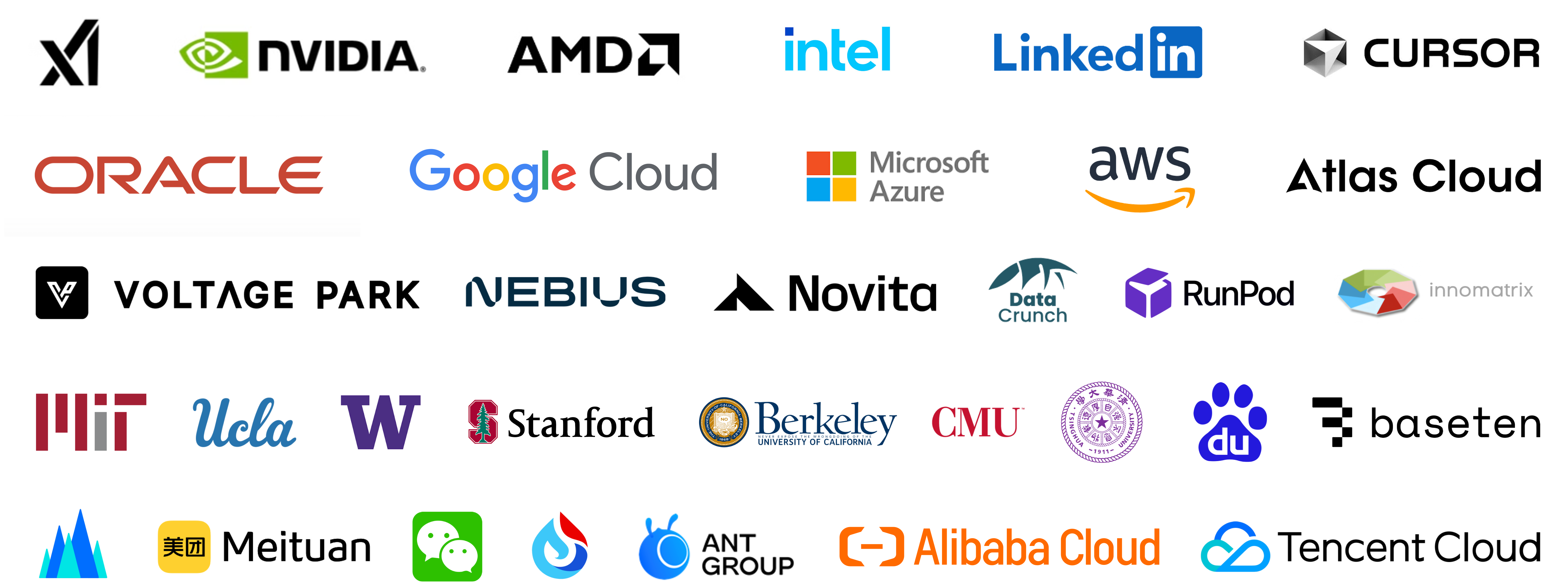
SGLang has been deployed at large scale, generating trillions of tokens in production each day. It is trusted and adopted by a wide range of leading enterprises and institutions, including xAI, NVIDIA, AMD, Intel, LinkedIn, Cursor, Oracle Cloud, Google Cloud, Microsoft Azure, AWS, Atlas Cloud, Voltage Park, Nebius, DataCrunch, Novita, RunPod, InnoMatrix, Modal, MIT, UCLA, the University of Washington, Stanford, UC Berkeley, Tsinghua University, Baseten, Baidu, AntGroup, Alibaba, Tencent, and other major technology organizations. As an open-source LLM inference engine, SGLang has become the de facto industry standard, with deployments running on over 400,000 GPUs worldwide. SGLang is currently hosted under the non-profit open-source organization LMSYS.
Contact Us
For enterprises interested in adopting or deploying SGLang at scale, including technical consulting, sponsorship opportunities, or partnership inquiries, please contact us at sglang@lmsys.org.
Long-term active SGLang contributors are eligible for coding agent sponsorship, such as Cursor, Claude Code, or OpenAI Codex. Email sglang@lmsys.org with your most important commits or pull requests.
Acknowledgment
We learned the design and reused code from the following projects: Guidance, vLLM, LightLLM, FlashInfer, Outlines, and LMQL.